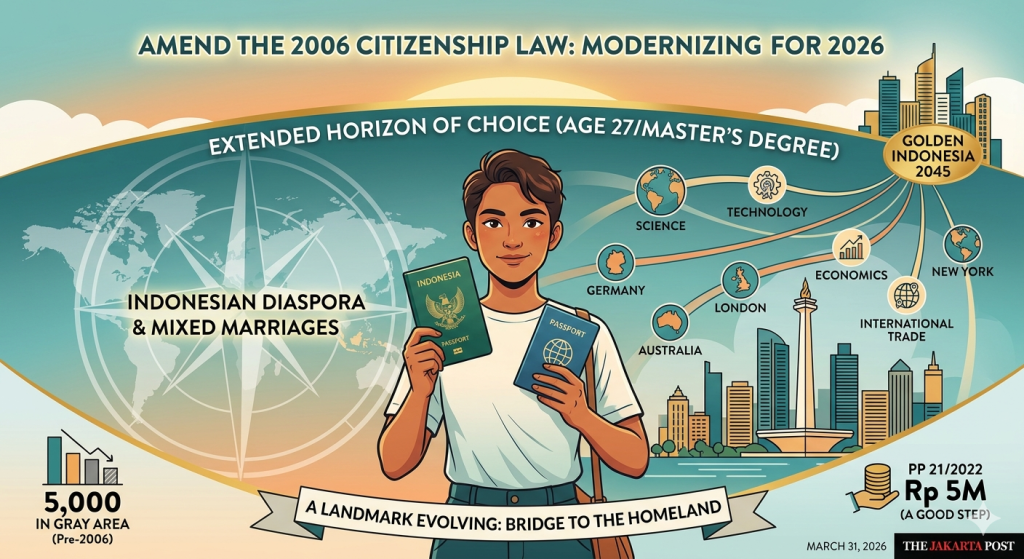

Law No. 12/2006 on citizenship has served as a landmark piece of legislation. It has worked well for the past two decades. This law is vital for children of mixed-heritage families. These children are born from marriages between Indonesian citizens and foreign nationals.
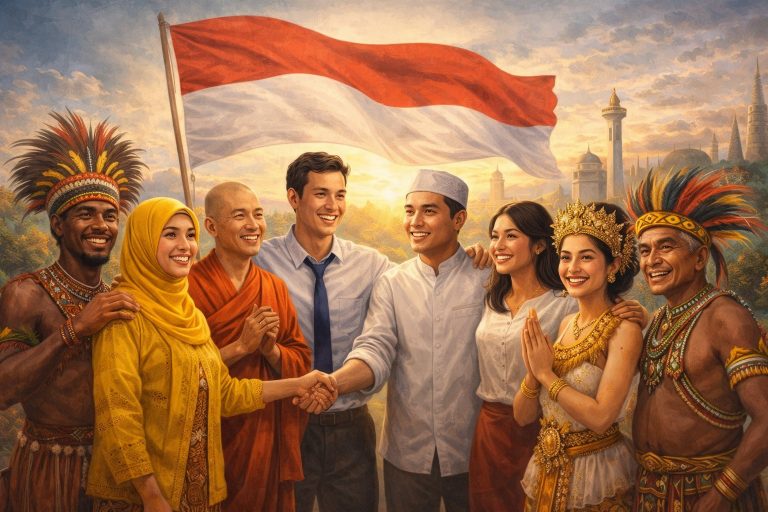
According to the Great Dictionary of the Indonesian Language, mixed-heritage individuals represent the intersection of two cultures. They often possess a unique dual identity. This makes them natural global citizens.
Meanwhile, the broader Indonesian diaspora continues to grow. They form a vast network of potential contributors to the nation.
The 2006 Citizenship Law: A Historic Milestone for Human Rights
At its inception, the law was a milestone for human rights in Indonesia. It was highly revolutionary compared to the previous Law No. 62/1958.
The law provided long-overdue legal protection to Indonesian women married to foreign men. It ensured that their children were not rendered stateless or automatically foreign.
It also introduced the concept of limited dual citizenship. This allowed these children to hold two passports until the age of 21. For 20 years, this served as a “role model” law.
Why Indonesia Needs to Amend the Citizenship Law in 2026
However, the world in 2026 is vastly different from that in 2006. Our citizenship framework must evolve as technology erases physical borders.
We are currently witnessing a war for talent among nations. Countries like Singapore, Germany, and Australia are actively courting skilled young professionals.
If Indonesia does not adapt, we risk a massive “brain drain”. Talented children of mixed heritage might flee to other nations. This happens because our administrative processes are too rigid. Their window of choice is also too narrow.
The Strict Deadlines and Legal Gray Areas for Mixed-Heritage Children
While the 2006 law was a step forward, it left significant gaps. Children born before the law’s passage were given a strict four-year window to determine their status. This window lasted from Aug. 1, 2006, to Aug. 1, 2010.
Many families were unaware of the deadline. Others were caught in bureaucratic red tape and missed it.
Today, an estimated 5,000 individuals find themselves in a legal gray area. They failed to determine their status despite living as Indonesians their entire lives.
The Dilemma of Choosing Nationality at Age 21
For those born after 2006, the challenge is the current age limit of 21 years. They must choose a single nationality between the ages of 18 and 21. In practice, this period is when most young adults are still pursuing university degrees. Some are just entering the workforce.
Forcing a life-altering legal decision during such an unstable stage often leads to difficult choices. Youths often choose their father’s nationality for educational scholarships or international mobility. They do this even if their heart remains in the motherland.
As a result, Indonesia loses a skilled citizen. They lose them before they can contribute to the national economy.
Breaking Down Administrative Hurdles and Tax Barriers
Government Regulation No. 21/2022 was a welcome breakthrough. It replaced the older regulation No. 2/2007.
It simplified requirements and set a manageable fee of Rp 5 million. This earned it the nickname the “five-million-rupiah PP” among mixed couples. This was a vital acknowledgement that the cost should not be a barrier for our own people.
However, administrative hurdles remain. Many children born in Indonesia to mixed-heritage families lack stay permits.
The law should be flexible. It should allow population biodata from the Civil Registration Service to serve as valid proof.
Furthermore, we must address the middle-class hurdles of taxes and asset ownership. To truly feel like citizens, these individuals must have the right to own property. They should be exempt from foreign tax brackets as children of Indonesian nationals.
Extending the Horizon of Choice to Boost the National Economy
The solution lies in extending the horizon of choice. The deadline to choose citizenship should be extended. It should last until the individual has completed a master’s degree or reached 27.
This age reflects the reality of modern professional development. It gives young adults the time to finish their specialized training abroad. They can then return to Indonesia with skills in science, technology, and economics.
These individuals are more than just “assets”. They are bridges. Their cross-cultural backgrounds make them naturally adept at diplomacy and international trade.
They possess the blood and spirit of Indonesia. They combine this with high-level education and global networks. This could catalyze Indonesia’s goal of becoming a top five global economy.
Redefining the Diaspora for Golden Indonesia 2045
We must look toward Golden Indonesia 2045. The new amendment to the Citizenship Law must also redefine the diaspora.
We should consider extending this definition to the third generation. This includes grandchildren of former Indonesian citizens.
This “right of return” would allow those with Indonesian heritage to reconnect with their roots. They would not face the grueling hurdles that unrelated foreign nationals currently face.
Improving this law is about more than just paperwork. It is about creating a conducive climate. It invites the global Indonesian community to contribute to national development. They deserve a legal framework that makes them feel at home. It should empower them to serve their country.
Jakarta | Tue, March 31, 2026
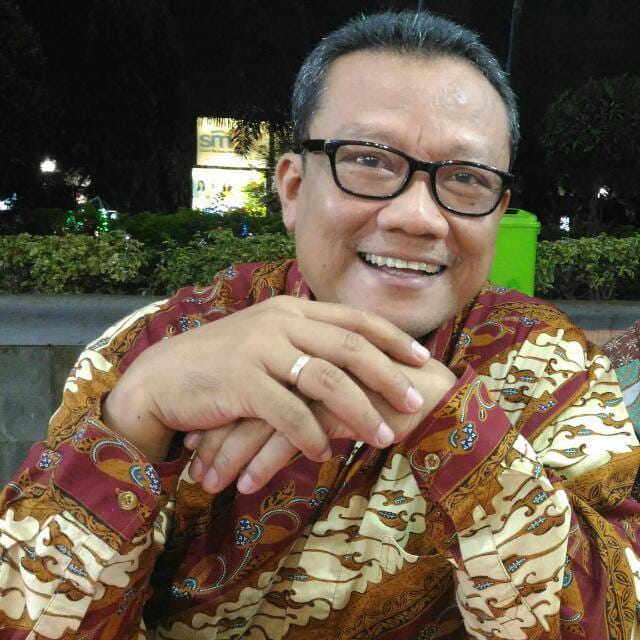
By: Paschasius Hosti Prasetyadji (The Jakarta Post)
The writer is a senior researcher at the Indonesian Citizenship Institute (IKI).